


When Alejandro Bonilla Jr walks on set or steps in front of a canvas, he carries the Bronx with him. He also carries his father’s drafting table, the long nights watching a Honduran painter bring comic book panels to life, and the weight of every stereotype that tried to tell him what a Black man from his neighborhood was supposed to be.
Today Alejandro is a multidisciplinary artist, actor, and illustrator who splits his time between painting, performing, and a day job at an architecture firm in Chelsea. His work has been shown in galleries across New York City and profiled by the Village Voice, which describes his “Afro Nouveau” style as a way of carving space for Black narratives too often left out of the frame. The Village Voice
On our Secret Sauce episode, we talked about the mythic power of his paintings, the reality of balancing art and survival, and why his Nuvee film picks all circle back to tenderness, family, and the many versions of Blackness that rarely get center stage.
The full 22 minute conversation is available to watch in the embedded Secret Sauce interview below.
Alejandro’s earliest memory of art is not a museum or gallery. It is his father’s giant drafting table covered in comic pages, papers, and characters in motion. As a kid, he would sit right on the edge of that table, watching his dad disappear into the zone for hours at a time, building a world line by line.
That table set his trajectory. When it came time to choose a high school, he followed his father’s path into the High School of Art and Design, then continued through the Art Students League, the School of Visual Arts, and finally the Fashion Institute of Technology, where he earned his BFA in Illustration.
Years later, the Village Voice would frame that arc as a story of talent and resilience, noting how those classrooms sharpened his craft while also exposing a gap. The images on the walls rarely looked like him or his family. That absence, the article explains, became the seed of his mission.
“I wanted to be the artist who could put eyes on Black artists more,” Alejandro says there. “I lacked that representation as an art student, so I wanted to make that space for others.”
Alejandro thinks of himself as a “creative” first. He paints. He acts on stage and on screen. He writes and develops his own indie films. For him those are not separate lanes. They are different ways of doing the same job.
Illustration school taught him that the work is about selling an idea or feeling. An illustration does not just render a figure. It arranges elements so that a viewer understands a story in a single glance. Acting, he realized, is the same craft in a different medium. You use your body, voice, and presence instead of pen and paint, but the goal is still to bring emotion into the physical world.
On set, that mindset shows up in his willingness to play and improvise. In our collaboration on Nukhu sketches and short pieces, Alejandro often had to lean into comedic characters and loose dialogue. It pushed him out of his comfort zone as someone who had long imagined himself in more serious, dramatic roles, yet he found a new side of his performance range in the process.
If you scroll through Alejandro’s portfolio or see his work in person, one thing lands immediately. His figures are Black, radiant, and often placed in mythic or heightened settings.
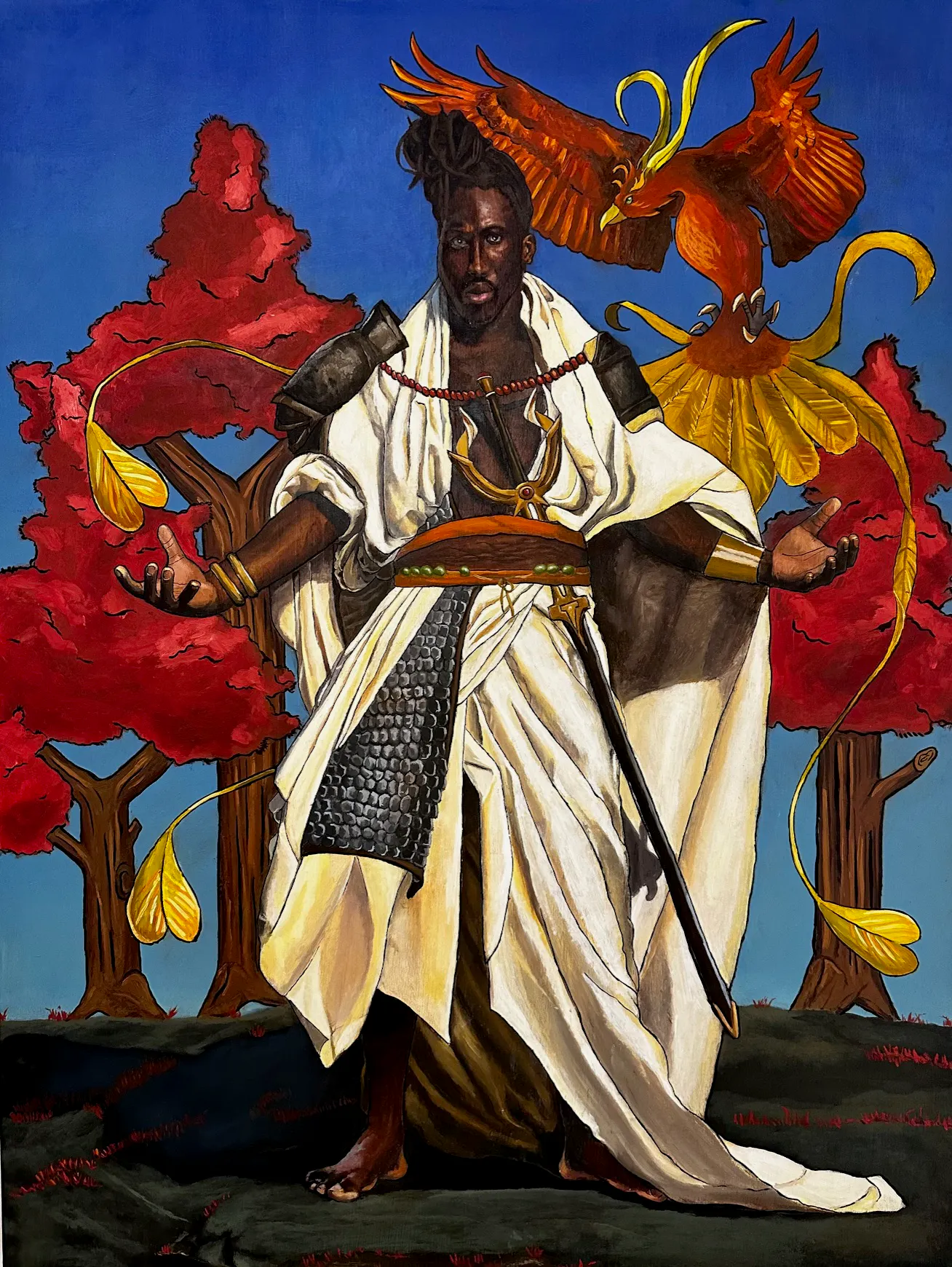
The painting shown here is a good example. A Black man stands barefoot on dark ground, draped in luminous white fabric and subtle armor. Behind him, red trees burn against a deep blue sky. A phoenix-like bird arcs overhead, all fire and gold feathers. The scene feels both ancient and futuristic, like a classical hero portrait reimagined through a Black sci fi lens.
When people encounter his paintings for the first time, Alejandro hopes they notice that “mystical beauty of blackness,” the sense that these figures belong in epic stories, not only in realist depictions of hardship. He wants viewers to think, “We need more of this. This should be everywhere.”
In the Village Voice piece, he describes his style as “Afro Nouveau,” a blend of Art Nouveau’s flowing elegance with bold Afrocentric expression. His series The Black People’s World places vivid Black figures against stark backdrops to challenge binary assumptions about who Black people are allowed to be.
That work is deeply personal. Growing up as the “weird art kid” in the Bronx, he felt how quickly his Blackness and masculinity were policed when he did not match a narrow mold. At different points he tried to change himself to fit in. That is one choice he says he would never repeat.
“There are several layers to Black boys and Black men, and we should all be able to live comfortably no matter what layer you are on,” he shares in our interview.
His paintings, and the characters inside them, give those layers room to breathe.
From the outside, Alejandro’s life can look like a clean narrative. Gallery shows. A growing portfolio at Art by ABon. A profile in the Village Voice. A recent grant from New York City that helped fund his studio and secure that feature.
Inside the day to day it feels more complex.
He works full time as a receptionist at an architecture firm in Chelsea. He commutes back to the Bronx. He auditions and books roles, develops work with his OBO collective, and chips away at a technically challenging painting that has stretched across an entire year. Somewhere in there he tries to rest and have a life.
The hardest part, he says, is time. Time to act, time to paint, time to simply think. That tension is familiar to anyone balancing a day job and a creative path. His practical solution is deceptively simple. He now lives by a planner and a calendar, tries not to compare his pace to anyone else’s, and keeps returning to the mantra he wrote on his Secret Sauce form: “Always create.”
Always does not mean every second of every day. It means that even in slow seasons, he finds a way to keep the line moving. A sketch on the train. A few strokes on a canvas before bed. A rehearsal for an upcoming scene. The point is to stay in motion so that when opportunity arrives he already feels like himself.
The city grant made that a little easier. Beyond the financial help, he sees it as a sign to keep going, a moment when the universe reminded him that what he is doing matters to people beyond his immediate circle. That validation, plus the Village Voice piece, gave him fresh energy to keep pushing his work into new spaces.
When we asked Alejandro to choose Nuvee recommendations, he went straight to films that complicate and deepen how Black life is seen on screen.
Reconciliation is a short film by New York filmmaker Ian Phillips. The project has already gained national recognition, winning the ABFF Black and Unlimited Fatherhood Showcase, sponsored by Walmart and BET. Ian Phillips: NYC FILMMAKER
Alejandro connects to the way it explores Black fatherhood and Black boyhood without flattening either. In a media landscape that still leans on tropes of absent or one dimensional Black fathers, a story that treats those relationships with care feels both rare and necessary. For someone whose own practice is about showing the full tapestry of Black experience, that kind of nuanced emotional storytelling is exactly what he wants to champion.
Watch Reconciliation on Nukhu:
https://nukhu.com/nuvee/1796
Alejandro’s second pick is Amakki, a lyrical documentary set in the coffee growing hills of Sidama in Ethiopia. The film follows two girls and two women who share a home and labor side by side, weaving a portrait of motherhood, girlhood, and work that is intimate and grounded. Amakki
The feature has earned major recognition, including Best Documentary Feature at the Atlanta Film Festival and the Montreal International Black Film Festival. Amakki
For Alejandro, Amakki speaks to his fascination with global Black and Brown life. It extends his mission beyond New York and the United States, reminding viewers that Black stories are not a single genre. They are rural and urban, quiet and epic, centered on women tending land and children as much as on men standing in armor.
Stream Amakki on Nukhu:
https://nukhu.com/nuvee/1807
Super High: A Period Piece by Bianca D. Lambert
His third recommendation is Super High: A Period Piece by Bianca D. Lambert. The film uses bold animation and humor to talk about menstruation, bodies, and pleasure in ways we rarely see on screen. Alejandro loves the craft of the animation and the way the piece smuggles education and perspective into something that feels playful and accessible.
Watch Super High: A Period Piece on Nukhu:
https://nukhu.com/nuvee/1793
Taken together, his Nuvee picks form a trio. A father and son working through history. Ethiopian women holding a household together under pressure. An animated short that centers Black women’s bodies with honesty and wit. Each one widens the lens on who gets to be seen and how.
Alejandro’s first indie film is in post production with plans for a private screening soon. He is building new work with his OBO collective and lining up future art shows with two fellow Bronx artists. He is also openly hoping that someone watching the Secret Sauce episode will be the agent or collaborator who wants to help him reach the next level.
“The dream call is an agent saying, ‘I have room on my roster for you. Let’s go to the upper echelons,’” he says, laughing but serious.
Whether that call arrives this month or years from now, he will be ready. There is a planner on his desk, a half finished painting on his easel, and another role waiting just offstage.
Portfolio: https://www.artbyabon.com/
Instagram: https://www.instagram.com/abonfire/
Watch the full Secret Sauce interview with Alejandro above to hear the conversation in his own words, then explore his paintings and film work for yourself.